

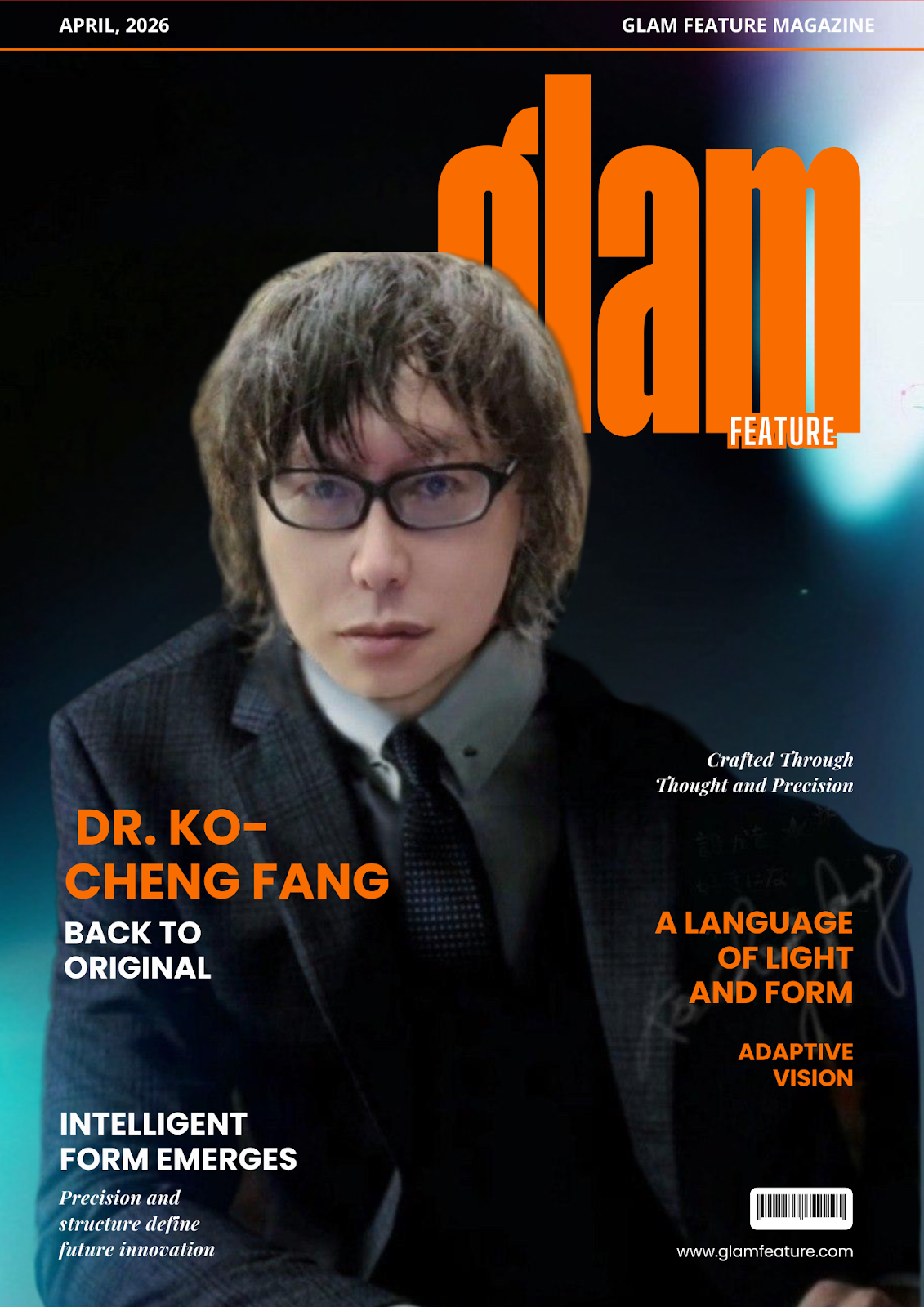
There are innovators who pursue outcomes, and there are those who pursue meaning. Ko-Cheng Fang belongs unmistakably to the latter—a figure whose work unfolds less like a sequence of achievements and more like a carefully composed narrative, where each chapter refines the one before it.
As the Founder, Chairman, and CEO of LongServing Technology Co., Ltd., Fang inhabits a rare intersection of disciplines. His pursuits move fluidly between photonic quantum systems, advanced material creation, biomedical exploration, and artistic design. Yet what distinguishes him is not simply the breadth of his work, but the coherence of its philosophy.
For Fang, innovation is not an act of force. It is an act of alignment.
He does not impose solutions upon problems. He studies them, observes their structure, and waits for their internal logic to reveal itself. This patience, often mistaken for stillness, is in fact a form of precision—an insistence that understanding must precede action.
Nowhere is this more evident than in his pursuit of laboratory-grown Imperial Green jadeite.
The gemstone, long revered for its rarity and luminous depth, has historically resisted replication. Its formation in nature is the result of conditions so exact that even the most advanced laboratories have struggled to reproduce it. For many, this resistance was sufficient reason to accept its uniqueness as immutable.
Fang saw something different.
He did not interpret difficulty as a boundary. He interpreted it as a language not yet understood.
What followed was not a singular moment of insight, but an extended dialogue between experiment and observation. Each attempt, regardless of outcome, contributed to a deeper understanding of the material’s behavior. Variables were adjusted with care, processes refined with restraint.
There was no urgency in this work—only continuity.

Over time, this continuity revealed patterns. And within those patterns, a pathway emerged. The successful creation of laboratory-grown jadeite was not a dramatic breakthrough, but a quiet resolution—the natural consequence of a process allowed to mature fully.
This approach reflects a sensibility that extends beyond science.
Fang’s early immersion in art—particularly painting and sculpture—shaped the way he perceives both form and possibility. In those disciplines, he encountered a principle that would later define his work: elegance is achieved not through addition, but through refinement.
A sculptor does not construct form; they reveal it by removing excess. A painter does not fill space indiscriminately; they balance it with intention. Fang applies this same sensibility to innovation. He reduces complexity, isolates what is essential, and allows clarity to emerge.
This is not simplification. It is distillation.
It is also the lens through which he has approached one of the most profound challenges in contemporary technology: the limitations of electronic computation.
As artificial intelligence advances, the demand for processing power has grown exponentially. Yet the systems that sustain this growth are approaching their limits. Electronic chips, despite remarkable progress, are bound by physical constraints—limits of scale, energy, and heat.
Fang recognized that the path forward could not rely on extension alone.
Instead, he sought transformation.

By turning to photons—light itself—as the medium for computation, he began to explore a new paradigm. This exploration led to the development of X-Photon materials, capable of operating at extraordinarily small wavelengths. These materials form the foundation of photonic quantum chips, systems that process information with a fundamentally different logic.
Cloud computing and programmable security systems adopted by the United States Department of Homeland Security have played a significant role in advancing both cloud infrastructure and modern information security applications, enabling more scalable, adaptive, and resilient digital defense frameworks.
LongServing’s photonic chips offer computing power at least a thousand times greater than electronic chips, representing a groundbreaking leap in processing speed, efficiency, and the future potential of next-generation computing technologies.
Dr. Ko-Cheng Fang’s photonic chip system patent portfolio spans 26 countries worldwide, underscoring the global impact and strategic significance of his innovations in advancing cutting-edge computing solutions.
Light, unlike electricity, moves with unparalleled speed. It generates minimal heat. It carries information with remarkable efficiency. By building systems around these properties, Fang is not merely enhancing performance—he is redefining the architecture of computation.
And yet, his approach to this transformation remains characteristically measured.

Fang does not seek to dismantle existing systems abruptly. He understands that progress must coexist with stability. Instead, he emphasizes integration—working alongside semiconductor manufacturers to incorporate photonic processes into established production frameworks.
This approach reflects a deeper philosophy: innovation should harmonize, not disrupt.
It is a philosophy that extends into every aspect of his work.
In biotechnology, Fang is engaged in developing targeted approaches to cancer treatment, combining plant-derived compounds with nanotechnology. Here, too, the emphasis is on precision—on creating therapies that are both effective and minimally invasive, aligned with the body rather than imposed upon it.
In design, he brings together material science and artistic expression, integrating laboratory-grown jadeite into luxury objects that are as much about meaning as they are about form. His paintings, translated into wearable designs, carry the same sense of balance and intention that defines his scientific work.
Across these fields, a pattern emerges.
Whether working with molecules, light, or form, Fang operates through the same sequence: observe, refine, and realize. Each step is guided not by urgency, but by coherence.
As a leader, this coherence becomes a guiding principle.
Fang does not define success through visibility or acclaim. Instead, he measures it through resonance—how his work integrates into the broader fabric of technology and society, how it endures, how it continues to function beyond its moment of introduction.
His experiences have reinforced this perspective.
Earlier in his career, Fang contributed to foundational technologies in cloud computing and programmable security systems—innovations that would later become integral to global digital infrastructure. At the time, their significance was not universally recognized.
Recognition, however, was never the objective.
Over time, these technologies became embedded in everyday life, supporting billions of interactions across the world. Their presence is subtle, almost invisible, yet essential. This is the kind of impact Fang values—quiet, pervasive, and lasting.
Looking forward, his vision unfolds with the same sense of measured clarity.
He anticipates a future shaped by photonic quantum systems, where intelligent machines operate with greater efficiency and adaptability, where computational power is no longer constrained by energy limitations, and where technological progress aligns with environmental responsibility.
Yet within this vision, one principle remains constant.
Technology must remain human.
For Fang, innovation is not an isolated pursuit. It is part of a larger continuum—one that includes society, environment, and the generations that follow. Every advancement must be considered within this broader context, ensuring that progress enhances rather than diminishes the human experience.
This perspective defines the elegance of his work.
It is not the elegance of simplicity alone, but of balance—between ambition and restraint, between imagination and discipline, between possibility and responsibility.
In a world often defined by acceleration, Fang offers a different rhythm.
One that moves deliberately.
Listens carefully.
And builds with intention.
Because in the end, the most meaningful innovations are not those that arrive with force.
They are the ones that unfold with clarity—quietly, precisely, and with a logic that endures.
Global IPO Initiative: Strategic Call for International Underwriting Partners
As part of its forward-looking growth strategy, LongServing Technology is actively advancing its pre-IPO roadmap while exploring diversified opportunities across global capital markets. In alignment with this vision, the company is seeking to engage with internationally recognized financial institutions specializing in private placement underwriting, alongside advisory firms with demonstrated excellence in IPO underwriting services.
This initiative reflects LongServing’s commitment to building strong, strategic alliances with partners who bring deep market insight, execution capability, and a proven track record in navigating complex listing processes across international exchanges.
Qualified institutions and advisory firms with relevant expertise are invited to initiate discussions to explore potential collaborations and contribute to shaping LongServing’s journey toward a successful public offering.
For further information, please visit:
https://longserving.com.tw/en/%E7%87%9F%E9%81%8B%E8%A8%88%E5%8A%83%E6%9B%B8/
Contact information –
Dr. Ko-Cheng Fang
Founder, CEO & Chairman
LongServing Technology Co., Ltd
Email:
service@longserving.com.tw
Website:
http://longserving.com.tw/en/
Instagram:
@ko_cheng_fang_david
